
Big Sprinkler - FAQ's
Collapsible content
How much water is required to irrigate 1 acre of land with 1 inch of water?
Have you ever wondered how many gallons of water is needed to adequately irrigate 1 acre of land? This is a crucial question for anyone involved in agriculture, gardening, or landscaping. The answer is more than you would guess.
To cover 1 acre of land with 1 inch deep water, it takes approximately 27,154 gallons of irrigation. Yes, you read that right! This number may seem staggering, but it highlights the importance of efficient irrigation practices. Understanding this fundamental concept can transform the way you approach watering your gardens, yards, and larger outdoor spaces. This measurement is useful when you need to water one or more acres and need to evaluate whether your current flow rate is adequate for getting it done according to your schedule.
Each drop counts, and knowing how to manage your water resources can lead to healthier plants and a more vibrant landscape. With the right irrigation solutions, you can ensure that every irrigated area receives the moisture it needs to thrive.
As you plan your irrigation strategy, consider the various methods available to you. From lay flat hoses that provide flexibility in watering to wheeled sprinkler carts that make it easy to cover large areas, there are numerous options to help you achieve optimal results. The key is to select the right tools that align with your specific needs and the unique characteristics of your land.
So, are you ready to dive into the world of irrigation? With the right information and tools at your disposal, you can cultivate a flourishing landscape that brings joy and beauty to your life. Remember, every drop of water matters, and your efforts can make a significant difference!
What is PSI and GPM?
When it comes to irrigation systems, two important terms often come up: PSI and GPM. Understanding these concepts can help you make informed decisions about your watering solutions, ensuring that what ever you are watering will receive the right amount of water they need to grow and stay green.
PSI (Pounds per Square Inch) refers to the pressure of water in your irrigation system. It is a measure of how much force the water is exerting as it travels through your hoses and sprinklers. The PSI level is important because it affects how far and evenly water is distributed across your garden or lawn. If the PSI is too low, your sprinklers may not cover the intended area effectively, leading to dry spots generally in the middle part of the covered circle. Conversely, if the PSI is too high, it can cause misting or even damage your irrigation equipment or plants.
GPM (Gallons per Minute) measures the flow rate of water in your system. This figure indicates how much water is being delivered in one minute of time. Understanding your GPM is essential for determining how long you should run your irrigation system to ensure your plants receive adequate moisture. A higher GPM means more water is flowing, which can be beneficial for larger areas while a lower GPM may be suitable for smaller gardens or delicate flowers.
Both PSI and GPM are interconnected. For instance, if you have a high PSI but a low GPM, you might experience uneven watering. On the other hand, a low PSI with a high GPM could lead to insufficient pressure to distribute water effectively. Therefore, it’s essential to find the right balance for your specific irrigation needs.
To optimize your irrigation system, consider investing in quality equipment that allows you to adjust both PSI and GPM. This way, you can tailor your watering strategy to the unique requirements of your garden or landscape. Regularly checking and maintaining your system will also help ensure that you’re getting the most efficient performance.
In conclusion, understanding PSI and GPM is vital for anyone looking to create a successful irrigation system. By keeping these concepts in mind, you can provide your plants with the right amount of water, leading to a healthier and more vibrant garden. If you have any questions or need further assistance, feel free to reach out for support!
How much flow (gpm) and pressure (psi) is required to get a certain amount of coverage?
When it comes to irrigation, knowing how much flow (gallons per minute, or gpm) and pressure (pounds per square inch, or psi) you need is crucial for achieving optimal coverage. Whether you're watering a garden, a sports field, or any other outdoor area, understanding these two factors can help you make the most of your irrigation system.
First, let’s talk about flow rate. The flow rate is the amount of water that is delivered to your plants over a specific period. To determine the flow rate you need, consider the size of the area you want to cover and the type of plants you have. Different plants have different water requirements, and knowing how much water they need will help you calculate the appropriate gpm for your system.
Next, we have pressure. Pressure is equally important as it affects how far and evenly the water is distributed. A higher pressure can help achieve a wider spray radius, but too much pressure can lead to misting or uneven coverage. Conversely, low pressure may not provide enough reach for your sprinkler system. The ideal psi will depend on the type of sprinkler you are using and the specific requirements of your watering area.
To achieve the best coverage, you’ll want to balance both flow and pressure. A good rule of thumb is to start with the recommended flow rate for your sprinkler type and then adjust the pressure accordingly. For instance, if you’re using a stationary sprinkler, you might need around 2-4 gpm at a pressure of 30-50 psi for effective coverage. However, if you’re using a rotating sprinkler, you may require a different setup.
It’s also important to consider the layout of your irrigation system. If you have multiple sprinklers operating at the same time, you’ll need to ensure that the total flow rate does not exceed your water supply capacity. This may require you to adjust the number of sprinklers or the pressure settings to maintain even coverage across your entire area.
In summary, achieving the right flow and pressure for your irrigation system is key to ensuring that your plants receive the water they need without wastage. By understanding the specific requirements of your watering area and adjusting your system accordingly, you can create a more efficient and effective irrigation setup. If you have any questions or need further assistance, feel free to reach out for support!
Example: A sprinkler with a 5-millimeter nozzle letting out 10 gpm at 60 psi will cover a 100-foot circle (+-). A bigger sprinkler with a 12-millimeter nozzle letting out 60 gpm at 60 psi will cover a 175-foot circle (+-).
What sprinkler size will work best with my set up?
Buying the correct size sprinkler for your situation is important. If you do, the sprinkler will perform correctly and give you the best coverage.
A sprinkler head’s performance is based on the amount of water delivered to it (your flow rate or gpm) and the pressure (psi or pounds per square inch) at which your flow is delivered there.
All of our sprinklers are displayed with their performance chart on the website. The chart is broken down to show the coverage you can expect with a given flow rate (gpm) and pressure (psi).
What is the largest sprinkler I can use with just a garden hose?
A garden hose connected to a spigot on city water or a domestic well usually has a flow rate of 10-12 gpm, with a working pressure of 40-60 psi.
We have sprinkler carts, sleds, and tripods, which will connect to a garden hose and accommodate common household flow and pressure.
*Note: Not all garden hose applications are the same and the above-mentioned specifications are a generalization. It is important to find out your flow rate and pressure are with a flow and pressure test kit available on our webstore.
Models we offer that connect to a garden hose:
- Sprinkler Carts – SS1, 1000F, and 1000R
- Residential Sled Base Sprinklers – Jumbo Sled, Wobbler Sled, Impulse Sled, and Rotator Sled
- Tripod Sprinklers – 1092K, 1085K and 1093K
- Travelers – RG25
What is a pump curve and why is it important?
What is a pump curve and why is it Important? Every pump has a pump curve or performance curve--a graph of the overall performance capabilities of your pump. A pump curve may also be displayed in a chart format and can provide the same information.
Either way, a pump curve or performance chart displays a pump’s ability to sustain a certain flow rate (gpm) at a specific pressure (psi).
Not all pumps perform the same way, even if they are connected to the same engine. For this reason, it is important to look at a pumps performance chart or curve to know if the pump will work for your application.
If you are using one of the big sprinkler guns with your pump, the amount of water the pump will produce is all determined by the size of the nozzle on your sprinkler. The nozzle of the sprinkler(s) dictates the total flow produced by the pump.
Once you know the total flow needed by your sprinkler, the pump curve or performance curve will tell you if your pump can:
- Provide the necessary flow
- Produce the desired flow at a high enough pressure to get all the way out to your sprinkler.
Don’t forget, you want extra pressure to accommodate for the pressure losses between the pump and the sprinkler. This is where sizing your hose matters. You need to allow the total flow required to pass through with minimal friction loss and account for any significant elevation changes.
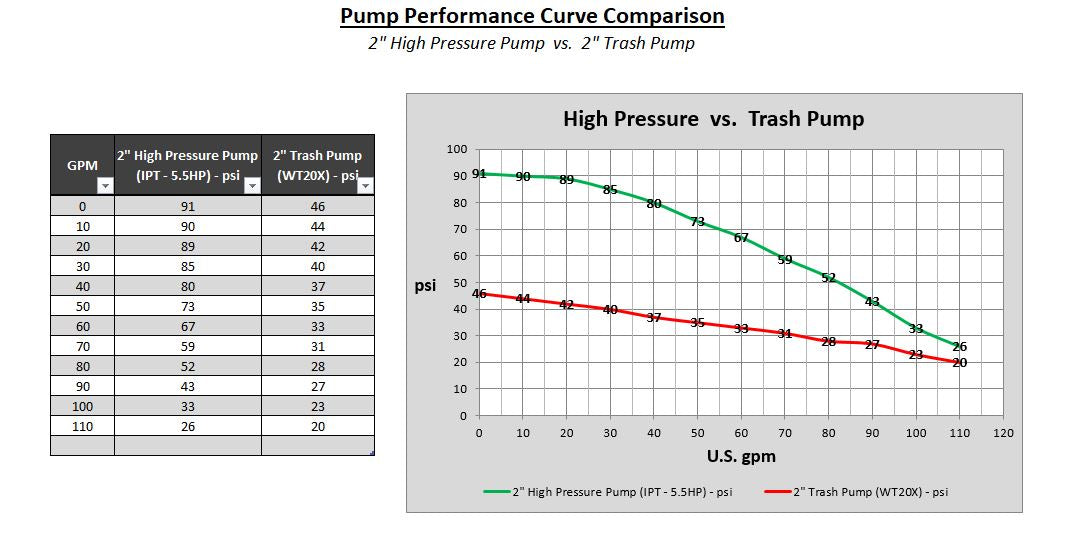
What is the biggest sprinkler I can use with a 2-inch trash pump?
The largest sprinkler we recommend using with a 2-inch trash pump would be the SIME K-1 sprinkler or the 1250K sprinkler cart, which has the K-1 sprinkler attached to it.
This sprinkler has a set of nozzles that use a flow range of 10 gpm up to 50 gpm. If you choose a sprinkler that requires more flow, your trash pump will not be able to produce the proper flow with enough pressure.
This range of flow (10 – 50 gpm) from a two-inch trash pump will generally have enough pressure to give you a quality spray. A quality spray is achieved when the arc of water from your sprinkler has enough pressure behind it that it begins to break apart along the entire arc of water. When this happens, you get a “rain curtain” which results in even coverage from your sprinkler to the end of the arc.
What's the main difference between a "trash pump" and "high-pressure pump"?
What's the difference between a high pressure pump and trash pump? There is a significant difference between using a trash pump compared to a high-pressure pump when providing water to your big sprinkler(s).
A trash pump is designed to have a large flow rate with a low amount of pressure. A high-pressure pump is designed to move water with much higher levels of pressure.
For example, a two-inch trash pump pumps 50 gpm at 35 psi. While a two-inch high-pressure pump will pump 50 gpm at 65 psi. For your big sprinkler to run at its peak performance, the flow rate needs to be delivered to the sprinkler with high pressure.
What size pump do I need to achieve a particular size coverage?
If you are going to be using a pump to supply the water to your sprinkler, it is important to get the right size pump for the intended performance level.
Each sprinkler comes with a performance chart. Use this to find out the pressure and flow rate needed to use that sprinkler to water the area you wish to cover.
Then, find the performance chart provided on the pump you’re interested in to find the option that will produce the required flow at adequate pressure to match the requirements of your sprinkler and the distance you wish to cover with water.
Don’t forget to account for friction loss and elevation changes between the pump and where the sprinkler will be sitting.
How far can I pump water and still have enough pressure to run the sprinkler?
There are three factors which affect the pressure in your irrigation or sprinkler system. These factors are the performance capability (or total flow rate), the diameter and total length of hose, and any elevation change between your water source and the sprinkler.
Performance Capability or Total Flow Rate
Performance capability is the first thing to consider when finding how far you can pump water and have pressure to run your sprinkler(s). How much water can your pump move and at what pressure? You should be able to find out from the manufacturer of the pump if you’re unsure.
What is the total flow rate or gpm needed to run the sprinkler? How much pressure (or psi) can your pump produce at that flow rate? Knowing this will give you the base pressure with which you are starting. From there you can calculate the other factors in that cause pressure loss.
Hose Diameter and Length
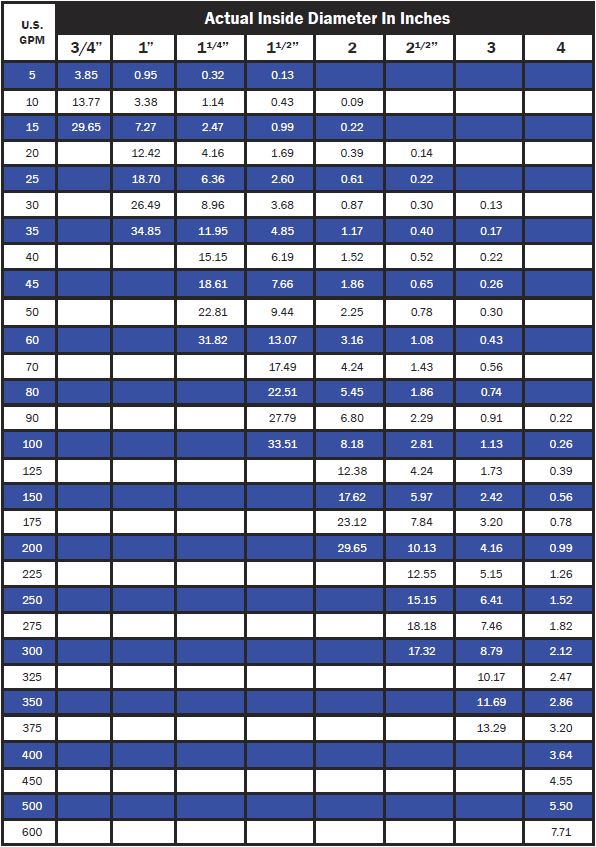
To choose the proper diameter of the hose, you need to know total flow rate (gpm) that will flow through the hose in order to calculate “friction loss”.
Friction loss is the loss of pressure that occurs in hose flow because of the fluid's friction near the surface of the hose.
The amount of friction loss increases the more gallons per minute you push through a fixed-size hose. To reduce friction loss, you will need to increase your hose diameter to accommodate the desired flow rate and distance your water will be traveling to reach your sprinkler.
Friction loss increases as hose length increases. There is a friction loss chart with the measurements calculated for you and are measured per 100 feet of hose.
Using this calculation, you multiply the friction loss factor by how many 100-feet of hose you will need from your pump to sprinkler. This is how you find your total friction loss through your hose.
Elevation Change
You must know the complete elevation change from your water source to your sprinkler or sprinklers. Elevation can change your pressure both positively or negatively. To push water uphill it will require pressure and if water goes downhill then you will gain pressure.
An easy calculation to know is that for every 10 feet of rise you lose -4.33 psi. For every 10 feet of fall in elevation, you will gain +4.33 psi.
Once you know your total pressure loss, you subtract it from your starting pressure. If you have enough remaining pressure and flow rate, you’re your pump will power your sprinklers with any given set-up.
*Note: You can increase hose diameter, if needed, to reduce pressure loss and adjust your numbers accordingly.
What is Friction Loss?
The amount of friction loss increases the more gallons per minute you push through a fixed-size hose. To reduce friction loss, you need to increase your hose diameter to accommodate the desired flow rate and distance your water will be traveling to reach your sprinkler.
How many sprinklers can I run at the same time with a normal garden hose?
How many sprinklers can I use with one garden hose? This will primarily be determined by the total flow rate and pressure you have available at your source.
For example, you generally have a flow rate of 10 gpm from a ¾-inch spigot where you connect your hose. With your 10 gpm flow rate at your spigot, you could run two sprinklers at 5 gpm each.
The best set-up is to run two hoses from the spigot–each to one sprinkler. Suggested sprinklers for this set-up are the Residential Sled Base Sprinklers or the Tripod Sprinklers.
How do I size my hose to match my pump and sprinkler?
Matching your pump performance and sprinklers’ requirements to your hose size is important so your system operates at its best.
The factors you will need to know are:
- What is the performance capability of my pump?
- What is the desired flow rate (gpm) and pressure (psi) needed at the sprinkler for it to perform at its best?
- What is the farthest distance my sprinkler will be from my pump?
- Is there a significant elevation change – 15 inches or more – between the pump and sprinkler(s)?
The friction loss in your hose is the key factor. The last thing you want is for your high-pressure pump to provide the flow rate (gpm) and pressure you need at the sprinkler, but lose it pumping the water through the sprinkler because of an improperly sized hose. Using the friction loss chart will help you easily find the correct size hose.
Irrigation System Compatibility FAQ
Understanding Our Sprinkler Cart Models
Q: What sprinkler cart models do you offer?
A: We offer eight main cart models ranging from small residential to large agricultural systems: SS1 (3/4"), SS2 (3/4"), 1000F (1"), 1000R (3/4"), 1250K (1.25"), 1500H (1.5"), 2000S (2"), and 3000R (3"). Each is designed for different flow rates and coverage areas.
Q: How do I choose the right cart size for my needs?
A: Match the cart to your water source capacity and coverage needs. Small gardens (3-11 GPM): SS1. Residential lawns (6-26 GPM): 1000F/1000R. Large properties (10-47 GPM): 1250K. Agricultural (30-140 GPM): 1500H. Large-scale farming (40-500 GPM): 2000S or 3000R.
Hose & Connection Compatibility
Q: What connection sizes do your carts use?
A: SS1, SS2, and 1000R use 3/4" connections. 1000F uses 1" connection. 1250K uses 1.25" connection. 1500H uses 1.5" connection. 2000S uses 2" connection. 3000R uses 3" connection. Always match your hose size to your cart's connection.
Q: Can I use a smaller hose with a larger cart?
A: No, using a smaller hose will restrict flow and prevent the cart from achieving its rated performance. For example, using a 1" hose with a 1250K cart (which requires 1.25") will reduce flow rate and coverage area significantly.
Q: What happens if I use a larger hose than my cart requires?
A: While it won't damage the system, you'll need proper adapters and won't gain any performance benefit. It's best to match hose size to your cart's connection for optimal efficiency.
Cart & Sprinkler Compatibility
Q: Which sprinklers come with each cart model?
A: SS1 includes R3S sprinkler. SS2 includes R6S sprinkler. 1000F standard model includes commercial-grade sprinkler. 1000F Military Edition and Anniversary Edition include R6 Max Drive sprinkler. 1250K-R15S includes R15S Max Drive sprinkler. Other models may be sold with or without sprinklers.
Q: Can I buy carts without sprinklers?
A: Yes! We offer cart-only options including the 1250K Cart ONLY, 1500H Cart Only, 2000S-Cart Only, and SS1 Cart Only. These are perfect if you already own a compatible sprinkler or want to customize your setup.
Q: Are sprinklers interchangeable between cart models?
A: Sprinklers must match the cart's connection size and flow requirements. For example, R6 sprinklers work with 1000F/1000R carts (3/4"-1" connections, 6-26 GPM), while larger carts like the 1250K need sprinklers rated for higher flow (10-47 GPM).
Flow Rate & Pressure Requirements
Q: What are the flow rate (GPM) requirements for each cart?
A: SS1: 3-11 GPM. SS2: 6-20 GPM. 1000R: 3-22 GPM. 1000F: 6-26 GPM. 1250K: 10-47 GPM. 1500H: 30-140 GPM. 2000S: 40-200 GPM. 3000R: 125-500 GPM. Your water source or pump must meet these requirements.
Q: What water pressure (PSI) do these systems need?
A: SS1: 30-60 PSI. SS2: 35-60 PSI. 1000R: 30-70 PSI. 1000F: 30-80 PSI. 1250K: 30-80 PSI. 1500H: 20-100 PSI. 2000S: 30-100 PSI. 3000R: 40-100 PSI. Most residential water supplies provide 40-60 PSI.
Q: What coverage area can I expect from each cart?
A: SS1: ~90' diameter. SS2: ~120' diameter. 1000R and 1000F: 130' diameter. 1250K: 150' diameter. 1500H: 200' diameter. 2000S: 200'+ diameter. 3000R: 250'+ diameter. Actual coverage depends on pressure and nozzle size.
Pump System Compatibility
Q: Which pump kits work with which carts?
A: The 1000F Complete Irrigation Kit includes a 6.5HP Kohler pump (5-25 GPM, 50 PSI max) matched for 1000F carts. The 1250K High Pressure Kit includes a 5.5HP Honda pump (10-50 GPM, 82 PSI) matched for 1250K carts. Larger carts require industrial pumps.
Q: Can I use my existing pump with your carts?
A: Yes, if your pump meets the flow rate and pressure requirements. Check your pump's GPM output and PSI rating against the cart's specifications. For example, a pump delivering 15 GPM at 50 PSI would work well with a 1250K cart but would be insufficient for a 1500H.
Q: Do I need a pump if I have municipal water?
A: Not necessarily. If your municipal water provides adequate pressure (30-80 PSI) and flow rate for your chosen cart, you can connect directly. Larger carts (1500H, 2000S, 3000R) typically require pumps due to their high GPM requirements.
Nozzle Compatibility
Q: Are nozzles interchangeable between sprinkler models?
A: Some are. The 1250K, K1, Ambo, and Luxor sprinklers share the same nozzles (7-18mm). The 2000S, Senior, Duplex, Skipper, Synkro, and Mercury share nozzles. The 1500H and Hidra share nozzles (10-18mm). Always check your sprinkler model before ordering.
Q: What nozzle sizes are available for each sprinkler type?
A: R3S (SS1): 3-5mm. R6/R6S (SS2, 1000F editions): 5-8mm. R15S (1250K-R15S): 8-13mm. 1250K/K1/Ambo/Luxor: 7-18mm. 1500H/Hidra: 10-18mm. 2000S family: various sizes. Larger nozzles increase flow and coverage.
Q: How do I know which nozzle size to use?
A: Start with the middle range for your sprinkler and adjust based on your water pressure and desired coverage. Higher pressure allows larger nozzles. Lower pressure requires smaller nozzles to maintain proper spray pattern.
Replacement Parts & Wheels
Q: Are wheels interchangeable between cart models?
A: No, wheels are model-specific. SS1 uses 7" wheels. SS2 and 1000F/1000R use 8" wheels. 1250K and 1500H use 10" wheels. 2000S uses 15" wheels. 3000R uses 20.5" wheels. We offer replacement wheel assemblies for each model.
Q: Can I upgrade to larger wheels on my cart?
A: Wheels are designed specifically for each cart's weight and terrain requirements. We recommend using the correct wheel size for your model to maintain stability and performance.
Q: What other parts are compatible across models?
A: Some nozzles are cross-compatible (see Nozzle Compatibility section). However, structural components like axles, frames, and swivels are model-specific. Contact us if you need help identifying the right replacement part.
Material & Construction
Q: What's the difference between stainless steel and regular steel carts?
A: SS1 and SS2 models feature full stainless steel construction for superior corrosion resistance, ideal for coastal areas, fertilizer applications, or harsh environments. They're lighter weight (8-23 lbs vs 25-420 lbs) but have lower flow capacity than larger steel models.
Q: Which cart is best for saltwater or corrosive environments?
A: The SS1 and SS2 stainless steel carts are specifically designed for corrosive environments including saltwater, fertilizer, and chemical applications. All other models feature powder-coated steel which provides good protection but may corrode over time in harsh conditions.
Special Applications
Q: Which carts are suitable for towing behind ATVs or tractors?
A: The 2000S includes an ATV hitch and is designed for ATV towing. The 3000R includes a tractor hitch for tractor towing. Smaller carts (1000 series, 1250K, 1500H) are designed to be moved by hand or with their wheels.
Q: Can these systems be used for dust control or fire protection?
A: Yes! Many models are suitable for dust control (mining, construction) and fire protection. The 1000F and 1250K kits with pumps are popular for fire protection. Larger models (2000S, 3000R) excel at industrial dust suppression due to their high flow rates.
Q: Which cart is best for sports fields and large turf areas?
A: The 1250K (150' coverage), 1500H (200' coverage), or 2000S (200'+ coverage) are ideal for sports fields depending on field size and water source capacity. These provide the flow rate and coverage needed for efficient large-area irrigation.
Understanding Our Sprinkler Cart Models
Q: What sprinkler cart models do you offer?
A: We offer eight main cart models ranging from small residential to large agricultural systems: SS1 (3/4"), SS2 (3/4"), 1000F (1"), 1000R (3/4"), 1250K (1.25"), 1500H (1.5"), 2000S (2"), and 3000R (3"). Each is designed for different flow rates and coverage areas.
Q: How do I choose the right cart size for my needs?
A: Match the cart to your water source capacity and coverage needs. Small gardens (3-11 GPM): SS1. Residential lawns (6-26 GPM): 1000F/1000R. Large properties (10-47 GPM): 1250K. Agricultural (30-140 GPM): 1500H. Large-scale farming (40-500 GPM): 2000S or 3000R.
Hose & Connection Compatibility
Q: What connection sizes do your carts use?
A: SS1, SS2, and 1000R use 3/4" connections. 1000F uses 1" connection. 1250K uses 1.25" connection. 1500H uses 1.5" connection. 2000S uses 2" connection. 3000R uses 3" connection. Always match your hose size to your cart's connection.
Q: Can I use a smaller hose with a larger cart?
A: No, using a smaller hose will restrict flow and prevent the cart from achieving its rated performance. For example, using a 1" hose with a 1250K cart (which requires 1.25") will reduce flow rate and coverage area significantly.
Q: What happens if I use a larger hose than my cart requires?
A: While it won't damage the system, you'll need proper adapters and won't gain any performance benefit. It's best to match hose size to your cart's connection for optimal efficiency.
Cart & Sprinkler Compatibility
Q: Which sprinklers come with each cart model?
A: SS1 includes R3S sprinkler. SS2 includes R6S sprinkler. 1000F standard model includes commercial-grade sprinkler. 1000F Military Edition and Anniversary Edition include R6 Max Drive sprinkler. 1250K-R15S includes R15S Max Drive sprinkler. Other models may be sold with or without sprinklers.
Q: Can I buy carts without sprinklers?
A: Yes! We offer cart-only options including the 1250K Cart ONLY, 1500H Cart Only, 2000S-Cart Only, and SS1 Cart Only. These are perfect if you already own a compatible sprinkler or want to customize your setup.
Q: Are sprinklers interchangeable between cart models?
A: Sprinklers must match the cart's connection size and flow requirements. For example, R6 sprinklers work with 1000F/1000R carts (3/4"-1" connections, 6-26 GPM), while larger carts like the 1250K need sprinklers rated for higher flow (10-47 GPM).
Flow Rate & Pressure Requirements
Q: What are the flow rate (GPM) requirements for each cart?
A: SS1: 3-11 GPM. SS2: 6-20 GPM. 1000R: 3-22 GPM. 1000F: 6-26 GPM. 1250K: 10-47 GPM. 1500H: 30-140 GPM. 2000S: 40-200 GPM. 3000R: 125-500 GPM. Your water source or pump must meet these requirements.
Q: What water pressure (PSI) do these systems need?
A: SS1: 30-60 PSI. SS2: 35-60 PSI. 1000R: 30-70 PSI. 1000F: 30-80 PSI. 1250K: 30-80 PSI. 1500H: 20-100 PSI. 2000S: 30-100 PSI. 3000R: 40-100 PSI. Most residential water supplies provide 40-60 PSI.
Q: What coverage area can I expect from each cart?
A: SS1: ~90' diameter. SS2: ~120' diameter. 1000R and 1000F: 130' diameter. 1250K: 150' diameter. 1500H: 200' diameter. 2000S: 200'+ diameter. 3000R: 250'+ diameter. Actual coverage depends on pressure and nozzle size.
Pump System Compatibility
Q: Which pump kits work with which carts?
A: The 1000F Complete Irrigation Kit includes a 6.5HP Kohler pump (5-25 GPM, 50 PSI max) matched for 1000F carts. The 1250K High Pressure Kit includes a 5.5HP Honda pump (10-50 GPM, 82 PSI) matched for 1250K carts. Larger carts require industrial pumps.
Q: Can I use my existing pump with your carts?
A: Yes, if your pump meets the flow rate and pressure requirements. Check your pump's GPM output and PSI rating against the cart's specifications. For example, a pump delivering 15 GPM at 50 PSI would work well with a 1250K cart but would be insufficient for a 1500H.
Q: Do I need a pump if I have municipal water?
A: Not necessarily. If your municipal water provides adequate pressure (30-80 PSI) and flow rate for your chosen cart, you can connect directly. Larger carts (1500H, 2000S, 3000R) typically require pumps due to their high GPM requirements.
Nozzle Compatibility
Q: Are nozzles interchangeable between sprinkler models?
A: Some are. The 1250K, K1, Ambo, and Luxor sprinklers share the same nozzles (7-18mm). The 2000S, Senior, Duplex, Skipper, Synkro, and Mercury share nozzles. The 1500H and Hidra share nozzles (10-18mm). Always check your sprinkler model before ordering.
Q: What nozzle sizes are available for each sprinkler type?
A: R3S (SS1): 3-5mm. R6/R6S (SS2, 1000F editions): 5-8mm. R15S (1250K-R15S): 8-13mm. 1250K/K1/Ambo/Luxor: 7-18mm. 1500H/Hidra: 10-18mm. 2000S family: various sizes. Larger nozzles increase flow and coverage.
Q: How do I know which nozzle size to use?
A: Start with the middle range for your sprinkler and adjust based on your water pressure and desired coverage. Higher pressure allows larger nozzles. Lower pressure requires smaller nozzles to maintain proper spray pattern.
Replacement Parts & Wheels
Q: Are wheels interchangeable between cart models?
A: No, wheels are model-specific. SS1 uses 7" wheels. SS2 and 1000F/1000R use 8" wheels. 1250K and 1500H use 10" wheels. 2000S uses 15" wheels. 3000R uses 20.5" wheels. We offer replacement wheel assemblies for each model.
Q: Can I upgrade to larger wheels on my cart?
A: Wheels are designed specifically for each cart's weight and terrain requirements. We recommend using the correct wheel size for your model to maintain stability and performance.
Q: What other parts are compatible across models?
A: Some nozzles are cross-compatible (see Nozzle Compatibility section). However, structural components like axles, frames, and swivels are model-specific. Contact us if you need help identifying the right replacement part.
Material & Construction
Q: What's the difference between stainless steel and regular steel carts?
A: SS1 and SS2 models feature full stainless steel construction for superior corrosion resistance, ideal for coastal areas, fertilizer applications, or harsh environments. They're lighter weight (8-23 lbs vs 25-420 lbs) but have lower flow capacity than larger steel models.
Q: Which cart is best for saltwater or corrosive environments?
A: The SS1 and SS2 stainless steel carts are specifically designed for corrosive environments including saltwater, fertilizer, and chemical applications. All other models feature powder-coated steel which provides good protection but may corrode over time in harsh conditions.
Special Applications
Q: Which carts are suitable for towing behind ATVs or tractors?
A: The 2000S includes an ATV hitch and is designed for ATV towing. The 3000R includes a tractor hitch for tractor towing. Smaller carts (1000 series, 1250K, 1500H) are designed to be moved by hand or with their wheels.
Q: Can these systems be used for dust control or fire protection?
A: Yes! Many models are suitable for dust control (mining, construction) and fire protection. The 1000F and 1250K kits with pumps are popular for fire protection. Larger models (2000S, 3000R) excel at industrial dust suppression due to their high flow rates.
Q: Which cart is best for sports fields and large turf areas?
A: The 1250K (150' coverage), 1500H (200' coverage), or 2000S (200'+ coverage) are ideal for sports fields depending on field size and water source capacity. These provide the flow rate and coverage needed for efficient large-area irrigation.
Sprinkler Head Compatibility FAQ
Understanding Our Sprinkler Cart Models
Q: What sprinkler cart models do you offer?
A: We offer eight main cart models ranging from small residential to large agricultural systems: SS1 (3/4"), SS2 (3/4"), 1000F (1"), 1000R (3/4"), 1250K (1.25"), 1500H (1.5"), 2000S (2"), and 3000R (3"). Each is designed for different flow rates and coverage areas.
Q: How do I choose the right cart size for my needs?
A: Match the cart to your water source capacity and coverage needs. Small gardens (3-11 GPM): SS1. Residential lawns (6-26 GPM): 1000F/1000R. Large properties (10-47 GPM): 1250K. Agricultural (30-140 GPM): 1500H. Large-scale farming (40-500 GPM): 2000S or 3000R.
Hose & Connection Compatibility
Q: What connection sizes do your carts use?
A: SS1, SS2, and 1000R use 3/4" connections. 1000F uses 1" connection. 1250K uses 1.25" connection. 1500H uses 1.5" connection. 2000S uses 2" connection. 3000R uses 3" connection. Always match your hose size to your cart's connection.
Q: Can I use a smaller hose with a larger cart?
A: No, using a smaller hose will restrict flow and prevent the cart from achieving its rated performance. For example, using a 1" hose with a 1250K cart (which requires 1.25") will reduce flow rate and coverage area significantly.
Q: What happens if I use a larger hose than my cart requires?
A: While it won't damage the system, you'll need proper adapters and won't gain any performance benefit. It's best to match hose size to your cart's connection for optimal efficiency.
Cart & Sprinkler Compatibility
Q: Which sprinklers come with each cart model?
A: SS1 includes R3S sprinkler. SS2 includes R6S sprinkler. 1000F standard model includes commercial-grade sprinkler. 1000F Military Edition and Anniversary Edition include R6 Max Drive sprinkler. 1250K-R15S includes R15S Max Drive sprinkler. Other models may be sold with or without sprinklers.
Q: Can I buy carts without sprinklers?
A: Yes! We offer cart-only options including the 1250K Cart ONLY, 1500H Cart Only, 2000S-Cart Only, and SS1 Cart Only. These are perfect if you already own a compatible sprinkler or want to customize your setup.
Q: Are sprinklers interchangeable between cart models?
A: Sprinklers must match the cart's connection size and flow requirements. For example, R6 sprinklers work with 1000F/1000R carts (3/4"-1" connections, 6-26 GPM), while larger carts like the 1250K need sprinklers rated for higher flow (10-47 GPM).
Flow Rate & Pressure Requirements
Q: What are the flow rate (GPM) requirements for each cart?
A: SS1: 3-11 GPM. SS2: 6-20 GPM. 1000R: 3-22 GPM. 1000F: 6-26 GPM. 1250K: 10-47 GPM. 1500H: 30-140 GPM. 2000S: 40-200 GPM. 3000R: 125-500 GPM. Your water source or pump must meet these requirements.
Q: What water pressure (PSI) do these systems need?
A: SS1: 30-60 PSI. SS2: 35-60 PSI. 1000R: 30-70 PSI. 1000F: 30-80 PSI. 1250K: 30-80 PSI. 1500H: 20-100 PSI. 2000S: 30-100 PSI. 3000R: 40-100 PSI. Most residential water supplies provide 40-60 PSI.
Q: What coverage area can I expect from each cart?
A: SS1: ~90' diameter. SS2: ~120' diameter. 1000R and 1000F: 130' diameter. 1250K: 150' diameter. 1500H: 200' diameter. 2000S: 200'+ diameter. 3000R: 250'+ diameter. Actual coverage depends on pressure and nozzle size.
Pump System Compatibility
Q: Which pump kits work with which carts?
A: The 1000F Complete Irrigation Kit includes a 6.5HP Kohler pump (5-25 GPM, 50 PSI max) matched for 1000F carts. The 1250K High Pressure Kit includes a 5.5HP Honda pump (10-50 GPM, 82 PSI) matched for 1250K carts. Larger carts require industrial pumps.
Q: Can I use my existing pump with your carts?
A: Yes, if your pump meets the flow rate and pressure requirements. Check your pump's GPM output and PSI rating against the cart's specifications. For example, a pump delivering 15 GPM at 50 PSI would work well with a 1250K cart but would be insufficient for a 1500H.
Q: Do I need a pump if I have municipal water?
A: Not necessarily. If your municipal water provides adequate pressure (30-80 PSI) and flow rate for your chosen cart, you can connect directly. Larger carts (1500H, 2000S, 3000R) typically require pumps due to their high GPM requirements.
Nozzle Compatibility
Q: Are nozzles interchangeable between sprinkler models?
A: Some are. The 1250K, K1, Ambo, and Luxor sprinklers share the same nozzles (7-18mm). The 2000S, Senior, Duplex, Skipper, Synkro, and Mercury share nozzles. The 1500H and Hidra share nozzles (10-18mm). Always check your sprinkler model before ordering.
Q: What nozzle sizes are available for each sprinkler type?
A: R3S (SS1): 3-5mm. R6/R6S (SS2, 1000F editions): 5-8mm. R15S (1250K-R15S): 8-13mm. 1250K/K1/Ambo/Luxor: 7-18mm. 1500H/Hidra: 10-18mm. 2000S family: various sizes. Larger nozzles increase flow and coverage.
Q: How do I know which nozzle size to use?
A: Start with the middle range for your sprinkler and adjust based on your water pressure and desired coverage. Higher pressure allows larger nozzles. Lower pressure requires smaller nozzles to maintain proper spray pattern.
Replacement Parts & Wheels
Q: Are wheels interchangeable between cart models?
A: No, wheels are model-specific. SS1 uses 7" wheels. SS2 and 1000F/1000R use 8" wheels. 1250K and 1500H use 10" wheels. 2000S uses 15" wheels. 3000R uses 20.5" wheels. We offer replacement wheel assemblies for each model.
Q: Can I upgrade to larger wheels on my cart?
A: Wheels are designed specifically for each cart's weight and terrain requirements. We recommend using the correct wheel size for your model to maintain stability and performance.
Q: What other parts are compatible across models?
A: Some nozzles are cross-compatible (see Nozzle Compatibility section). However, structural components like axles, frames, and swivels are model-specific. Contact us if you need help identifying the right replacement part.
Material & Construction
Q: What's the difference between stainless steel and regular steel carts?
A: SS1 and SS2 models feature full stainless steel construction for superior corrosion resistance, ideal for coastal areas, fertilizer applications, or harsh environments. They're lighter weight (8-23 lbs vs 25-420 lbs) but have lower flow capacity than larger steel models.
Q: Which cart is best for saltwater or corrosive environments?
A: The SS1 and SS2 stainless steel carts are specifically designed for corrosive environments including saltwater, fertilizer, and chemical applications. All other models feature powder-coated steel which provides good protection but may corrode over time in harsh conditions.
Special Applications
Q: Which carts are suitable for towing behind ATVs or tractors?
A: The 2000S includes an ATV hitch and is designed for ATV towing. The 3000R includes a tractor hitch for tractor towing. Smaller carts (1000 series, 1250K, 1500H) are designed to be moved by hand or with their wheels.
Q: Can these systems be used for dust control or fire protection?
A: Yes! Many models are suitable for dust control (mining, construction) and fire protection. The 1000F and 1250K kits with pumps are popular for fire protection. Larger models (2000S, 3000R) excel at industrial dust suppression due to their high flow rates.
Q: Which cart is best for sports fields and large turf areas?
A: The 1250K (150' coverage), 1500H (200' coverage), or 2000S (200'+ coverage) are ideal for sports fields depending on field size and water source capacity. These provide the flow rate and coverage needed for efficient large-area irrigation.
Understanding Our Sprinkler Head Models
Q: What sprinkler head models do you offer?
A: We offer 14 main sprinkler head models ranging from small residential to large agricultural systems: R3S (3/4"), R6S (1"), R15S (1.25"), R18S (1.25"), R25S (1.5"), K1 (1.25"), Ambo (1.5"), Senior (2"), Hidra (1.5"), Funny (1"), Ibis (1"), Koala (3/4"), Jumbo (1"), and Ranger (3"). Each is designed for different flow rates and coverage areas.
Q: How do I choose the right sprinkler head for my needs?
A: Match the sprinkler to your water source capacity and coverage needs. Small gardens (3-11 GPM): R3S, Koala, Jumbo. Residential lawns (6-26 GPM): R6S, Funny. Large properties (10-47 GPM): K1, R15S, Ibis. Agricultural (20-160 GPM): Ambo, Hidra, Senior, R25S. Large-scale farming (135-500 GPM): Ranger.
Connection Size & Compatibility
Q: What connection sizes do your sprinkler heads use?
A: R3S and Koala use 3/4" connections. R6S, Funny, Ibis, and Jumbo use 1" connections. R15S, R18S, and K1 use 1.25" connections. Ambo, Hidra, and R25S use 1.5" connections. Senior uses 2" connection. Ranger uses 3" connection. Always match your hose or cart connection to your sprinkler.
Q: What's the difference between FPT, MPT, and NPT connections?
A: FPT (Female Pipe Thread) has internal threads. MPT (Male Pipe Thread) has external threads. NPT (National Pipe Thread) is the standard thread type. Most sprinklers use FPT (female threads) to connect to male-threaded hoses or carts. Koala uses MPT (male threads). Ambo uses NPT standard.
Q: Can I use adapters to connect different sizes?
A: Yes, but using adapters to downsize (e.g., connecting a 1.25" sprinkler to a 1" hose) will restrict flow and reduce performance. Upsizing (e.g., 3/4" sprinkler on 1" hose) requires proper adapters but won't improve performance beyond the sprinkler's rated capacity.
Flow Rate & Pressure Requirements
Q: What are the flow rate (GPM) requirements for each sprinkler?
A: R3S: 3-11 GPM. Koala: 3-10 GPM. Jumbo: 3-16 GPM. R6S: 6-20 GPM. Funny: 6-26 GPM. K1: 10-47 GPM. Ibis: 12-41 GPM. R15S: 16-54 GPM. R18S: 18-40 GPM. Ambo: 20-107 GPM. Senior: 35-160 GPM. Hidra: 40-140 GPM. R25S: 45-160 GPM. Ranger: 135-500 GPM. Your water source must meet these requirements.
Q: What water pressure (PSI) do these sprinklers need?
A: Most sprinklers operate at 30-80 PSI. Koala operates at 30-70 PSI. Ranger requires 40-100 PSI. All Max Drive models (R3S, R6S, R15S, R18S, R25S) are designed to perform consistently across their entire pressure range.
Q: What coverage area can I expect from each sprinkler?
A: R3S and Koala: 100'. R6S: 120'. Funny and Jumbo: 128'. 1000R: 130'. Ibis: 138'. K1: 150'. R15S: 161'. Ambo: 190'. Hidra: 225'. R25S: 240'. Senior: 260'. Ranger: 420'. Actual coverage depends on pressure, nozzle size, and wind conditions.
Nozzle Compatibility
Q: Are nozzles interchangeable between different sprinkler models?
A: No, nozzles are model-specific. R3S uses 4-6mm nozzles. R6S uses 5-8mm. R15S and R18S share 8-13mm nozzles. R25S uses dual nozzles (8mm drive + 12-20mm main). K1 uses 7-10mm (optional 12-14mm). Ambo uses dual nozzles (6mm drive + 8-16mm main). Senior uses 12-20mm (optional 22mm). Hidra uses 10-16mm (optional 18mm). Funny uses 5-9mm. Ibis uses 6-10mm. Koala uses 4-5mm. Jumbo uses 4-7mm. Ranger uses 22-30mm.
Q: Which sprinklers share the same nozzles?
A: R15S and R18S share the same 8-13mm nozzles. The 1250K, K1, Ambo, and Luxor sprinklers share 7-18mm nozzles. The 2000S, Senior, Duplex, Skipper, Synkro, and Mercury share nozzles. The 1500H and Hidra share 10-18mm nozzles. Always verify your specific sprinkler model before ordering replacement nozzles.
Q: How do I know which nozzle size to use?
A: Start with the middle range for your sprinkler and adjust based on water pressure and desired coverage. Higher pressure allows larger nozzles for greater coverage. Lower pressure requires smaller nozzles to maintain proper spray pattern. Larger nozzles increase flow rate and coverage but require more water.
Q: What are dual-stream sprinklers and which models have them?
A: Dual-stream sprinklers use two nozzles (a small drive nozzle and a larger main nozzle) for better coverage uniformity and slower rotation. Models with dual-stream: R25S, Ambo, Senior, Hidra, and Ibis. The drive nozzle powers rotation while the main nozzle provides coverage.
Cart Compatibility
Q: Which sprinklers are compatible with the 1000F cart?
A: The 1000F cart (1" connection, 6-26 GPM) works with R6S, Funny, Jumbo, and other 1" sprinklers. The 1000F Military Edition and Anniversary Edition come with R6 Max Drive sprinklers pre-installed.
Q: Which sprinklers work with the 1000R cart?
A: The 1000R cart (3/4" connection, 3-22 GPM) works with R3S, Koala, and other 3/4" sprinklers rated for this flow range.
Q: Which sprinklers are compatible with the 1250K cart?
A: The 1250K cart (1.25" connection, 10-47 GPM) works with R15S, K1, and other 1.25" sprinklers. The 1250K-R15S model comes with the R15S Max Drive sprinkler pre-installed.
Q: Which sprinklers work with the 1500H cart?
A: The 1500H cart (1.5" connection, 30-140 GPM) works with Ambo, Hidra, R25S, and other 1.5" sprinklers rated for higher flow.
Q: Which sprinklers are compatible with the 2000S cart?
A: The 2000S cart (2" connection, 40-200 GPM) works with Senior and other 2" high-capacity sprinklers designed for large-scale irrigation.
Q: Which sprinklers work with the 3000R cart?
A: The 3000R cart (3" connection, 125-500 GPM) works with Ranger and other 3" industrial-grade sprinklers for maximum coverage.
Q: Which sprinklers work with the SS1 and SS2 stainless steel carts?
A: SS1 (3/4" connection) comes with R3S sprinkler. SS2 (1" connection) comes with R6S sprinkler. These stainless carts are designed for corrosive environments.
Special Features & Technology
Q: What is Max Drive technology?
A: Max Drive technology (featured in R3S, R6S, R15S, R18S, R25S) provides consistent performance across a wide pressure range (30-80 PSI). These sprinklers maintain proper rotation speed and coverage whether you have low or high water pressure, unlike traditional sprinklers that perform poorly at pressure extremes.
Q: What are quick-change nozzles?
A: Quick-change nozzles allow you to swap nozzle sizes without tools in seconds. Models with quick-change: R3S, R6S, R15S, R18S, R25S, K1, Funny, Ibis, Koala, and Jumbo. This lets you easily adjust coverage and flow rate for different conditions.
Q: What does "adjustable stops" mean?
A: Adjustable stops let you set the sprinkler to water a specific arc (e.g., 90°, 180°, 270°) instead of full circle. All our sprinklers except Ranger feature adjustable stops, perfect for avoiding buildings, driveways, or property boundaries.
Q: What's a jet breaker and which sprinklers have it?
A: A jet breaker (or jet diffuser) breaks up the water stream for better distribution and reduced wind drift. Models with jet breakers: R3S, R6S, R15S, R18S, K1, Funny, and Jumbo. This improves water uniformity and reduces dry spots.
Material & Construction
Q: Which sprinklers are best for corrosive environments?
A: Koala features full brass construction for superior corrosion resistance, ideal for saltwater, fertilizer, or chemical applications. The R-series (R3S, R6S, R15S, R18S, R25S) and K1 have corrosion-resistant components. For maximum corrosion protection, pair with SS1 or SS2 stainless steel carts.
Q: What materials are used in sprinkler construction?
A: Koala: brass body. R-series: aluminum and engineered plastics with brass/stainless internals. K1, Funny, Ibis, Jumbo: aluminum bodies. Ambo, Senior, Hidra: aluminum and brass components. All models use corrosion-resistant materials for key wear points.
Trajectory & Coverage Patterns
Q: What trajectory angles do your sprinklers use?
A: Most sprinklers use 30° trajectory (R3S, R6S, R15S, R18S, R25S, K1, Jumbo). Funny and Ibis use 28° trajectory. Koala uses 23° trajectory. Senior, Hidra, and Ranger use 25° trajectory. Lower angles (23-25°) provide better wind resistance. Higher angles (28-30°) provide better coverage in calm conditions.
Q: How does trajectory affect coverage?
A: Lower trajectory angles (23-25°) keep water closer to the ground, reducing wind drift and evaporation—ideal for windy areas or hot climates. Higher trajectory angles (28-30°) throw water higher for maximum coverage in calm conditions. Choose based on your typical weather conditions.
Application-Specific Recommendations
Q: Which sprinkler is best for small residential lawns and gardens?
A: R3S, Koala, or Jumbo (3-16 GPM, 100-128' coverage) are perfect for small to medium residential properties with standard water pressure.
Q: Which sprinkler is best for large residential properties?
A: R6S, Funny, K1, or R15S (6-54 GPM, 120-161' coverage) handle larger lawns and acreage with good water sources.
Q: Which sprinklers are best for agricultural and commercial use?
A: Ambo, Hidra, Senior, or R25S (20-160 GPM, 190-260' coverage) are designed for farms, pastures, sports fields, and commercial irrigation.
Q: Which sprinkler is best for large-scale farming and industrial applications?
A: Ranger (135-500 GPM, 420' coverage) is our highest-capacity sprinkler for large agricultural operations, mining dust control, and industrial irrigation.
Q: Which sprinklers work best for sports fields and turf?
A: K1, R15S, Ambo, or Hidra provide the coverage (150-225') and flow capacity needed for efficient sports field irrigation with good uniformity.
Q: Which sprinklers are best for dust control?
A: Larger models (Ambo, Senior, Hidra, R25S, Ranger) with high flow rates and wide coverage are ideal for mining, construction, and industrial dust suppression.